

The First Step to Recovering From System Collapse
(Summary) Decompensation can leave you feeling as though your ability to cope has disappeared overnight. Everyday responsibilities may suddenly feel impossible, leading many people to push themselves even harder in an attempt to catch up. Unfortunately, that often makes recovery take longer. In this article, you’ll learn why reducing demands is the first step in recovering from decompensation and how protecting your available capacity can help your nervous system begin to recover.
When people decompensate, what I also call “system collapse,” everyday life can suddenly become much harder. Things that normally feel manageable may become overwhelming. You may dissociate more, struggle to think clearly, or find yourself unable to use coping skills that usually help.
Why pushing harder often backfires
To understand why pushing harder can actually prolong system collapse, we need to look at why the collapse happens. Decompensation happens when the demands upon the person exceed the person’s resources or ability to cope:
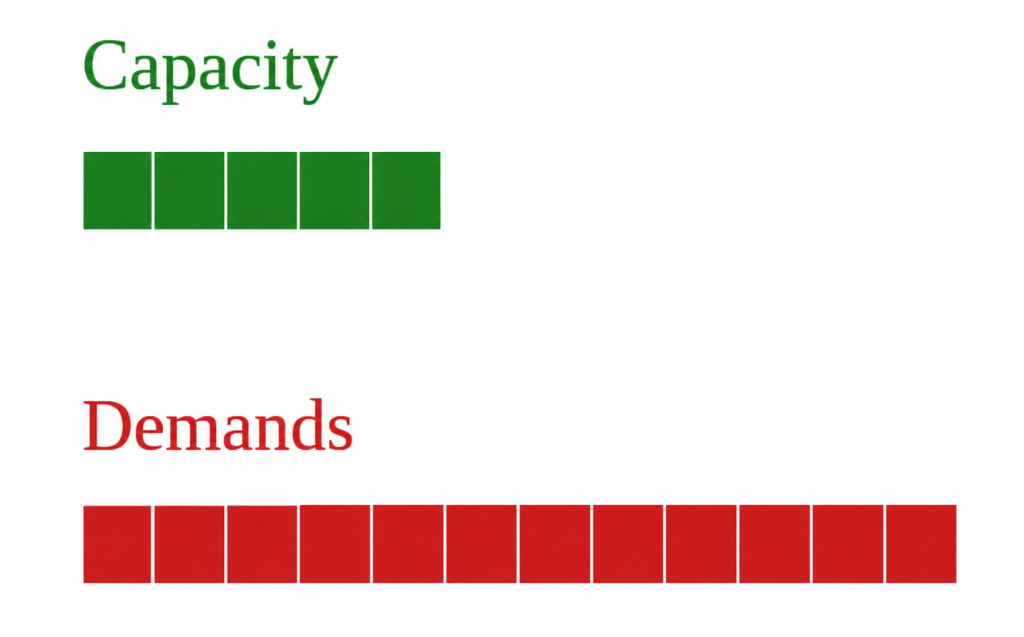
In this graphic, available capacity is the amount of mental, emotional, physical, and nervous system resources your system has available to meet today’s demands. In the chronic illness community, they often talk about having spoons and how many spoons something will take. You can imagine this graphic is talking about spoons if you prefer.
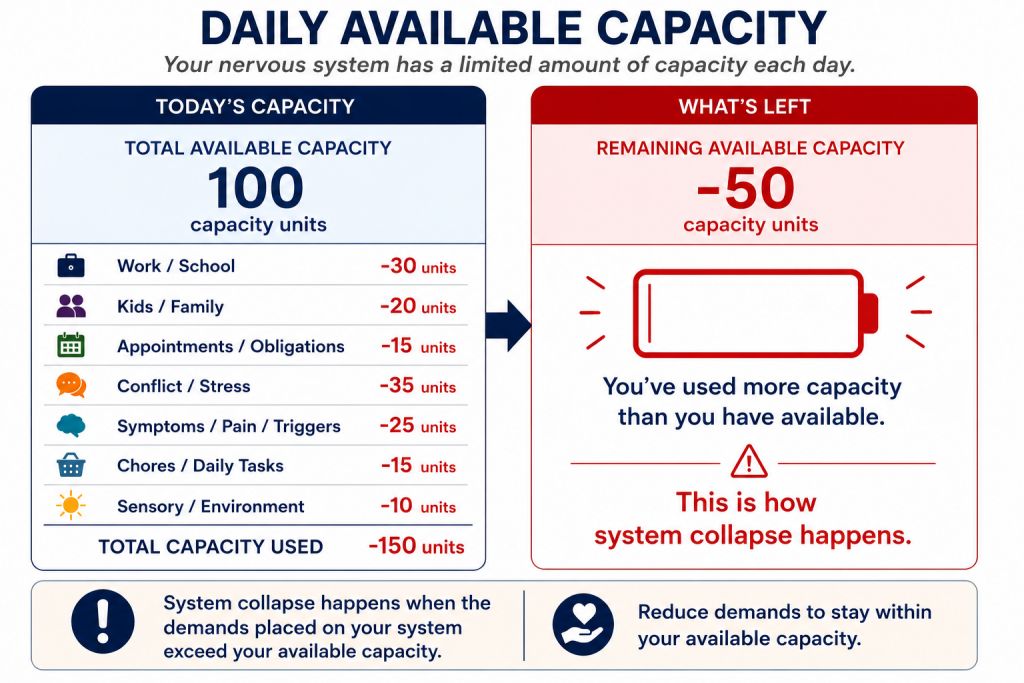
As you can see, decompensation has nothing to do with a person being lazy or weak. It has to do with being overwhelmed by more demands than the person has resources to handle.
So understanding this, you can appreciate that pushing yourself is unlikely to help because it becomes an additional demand on your already over-taxed system. This includes the things you say to yourself, such as:
- I have to catch up.
- I should be able to do this.
- I don’t have time to rest.
I’ve put together a resource for you with 15 thoughts that add pressure that people commonly say to themselves paired with pressure-reducing thoughts. You’ll find the link in the description.
Recovery begins by reducing demands
Decompensation or system collapse is a psychological emergency. This is a time to focus on only things that must get done. A good first task may be to identify what can wait for the time being, such as:
- postpone unnecessary decisions
- reduce commitments
This is also a time to do things the easy way, even if it’s not the way you’d prefer to do it normally. For instance, eat simple meals. You can find great ideas for simple meals if you look up “simple meals for ADHD.” Lowering expectations just for the present is another way to reduce demands and pressure.
Additional ways to reduce demands include using external supports such as a calendar, a reminder alarm, or a friend’s help and to reduce sensory demands.
Recovery is supported by focusing on the essentials
Basic self-care can be crucial at these times. I’m talking about making sure you:
- eat
- drink enough water
- take your prescribed medications
- get sleep
These are foundational for your body’s performance and directly impact your capacity.
Reducing demands is only one side of recovery. In a future video, we’ll talk about the other side: how to gradually increase your available capacity.
Continue Exploring CommuniDID
CommuniDID includes nearly 1000 pages of educational content about DID, trauma, dissociation— including articles, Q&As, guides, and practical resources organized by topic.
New content is added regularly.
Browse All TopicsFREE Membership Open Now
- exclusive resources
- videos
- member Q&As
- and more
Frequently Asked Questions
Is decompensation permanent?
Not necessarily. Many people experience decompensation as a temporary reduction in their ability to cope when the demands on them exceed their available capacity. As those demands are reduced and your nervous system begins to recover, your functioning often gradually improves. Recovery usually happens over time rather than all at once.
Why does everything suddenly feel overwhelming?
When you decompensate, your available capacity is lower than usual. Tasks that were manageable a week ago may now require more mental, emotional, or physical resources than you currently have available. The tasks themselves haven’t necessarily changed—your available capacity has.
Should I push myself to get back to normal?
Pushing harder often slows recovery because it adds another demand to a system that is already overwhelmed. Instead, focus on reducing unnecessary demands, protecting your available capacity, and taking care of your basic needs. As your capacity gradually returns, you’ll be in a much better position to resume your usual responsibilities.
Does reducing demands mean giving up?
No. Reducing demands is a temporary recovery strategy, not a sign of failure. During decompensation, your goal isn’t to accomplish as much as possible—it’s to create the conditions that allow your nervous system to recover. As your available capacity increases, you can gradually begin taking on more again.
What should I focus on first during decompensation?
Start with the essentials. Make sure you’re eating, drinking enough water, taking prescribed medications, and getting as much rest as you can. Then look for ways to temporarily reduce demands by postponing non-urgent tasks, simplifying responsibilities, and accepting help when it’s available. Protecting your available capacity is often more important than trying to keep up with everything on your usual to-do list.
How long does it take to recover from decompensation?
There isn’t a single answer because recovery depends on many factors, including what contributed to the decompensation, your current stress level, your physical health, and the demands you’re facing. Some people recover relatively quickly, while others need more time. Rather than expecting an immediate return to normal, it may be more helpful to look for gradual improvements in your available capacity over days or weeks.
Have a question this page didn’t answer? Click “Yes” or “No” below and a comment box will appear where you can leave your question. Comments are reviewed but not made public.